Erasmus Pavilion
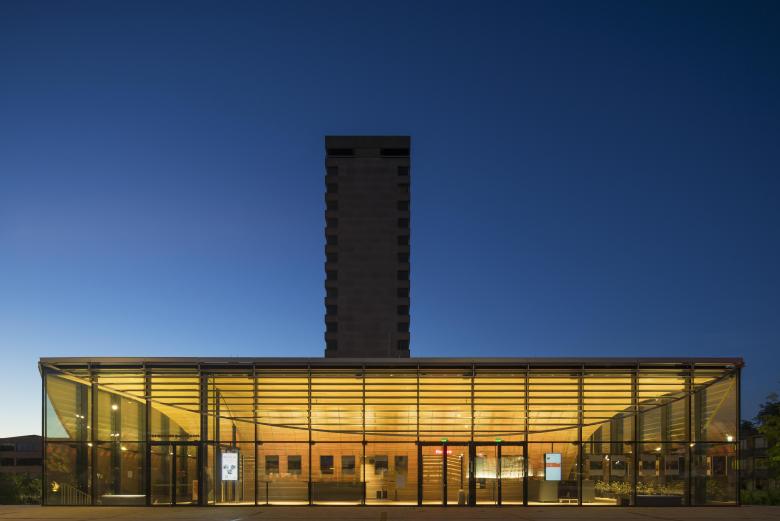
Powerhouse Company & De Zwarte Hond present the Erasmus Pavilion
Powerhouse Company & De Zwarte Hond's new student centre for Erasmus University Rotterdam is a welcome break among the tall Brutalist buildings of the university's suburban campus east of the city centre.
The Erasmus Pavilion is part of an ambitious masterplan by Juurlink + Geluk and Studio Sputnik to insert a social corridor through the heart of the campus; a programme including a new lake, food court, underground car park, system of circulation routes and re-landscaping.
The completed pavilion – won through a competition in 2010 – forms the vibrant and central gathering space; for research to meet business and science to meet culture. The building is at once a café, restaurant, bar, study zone, meeting centre and multi-purpose auditorium.
Transparency
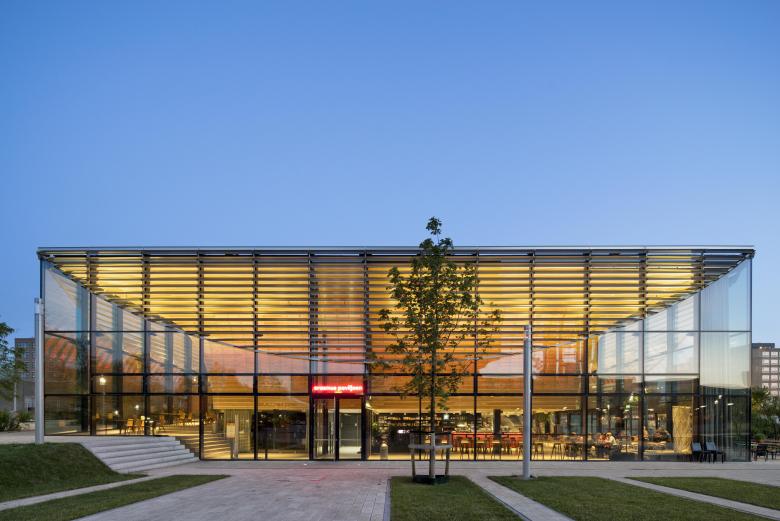
As a building to attract students, staff and external visitors alike, the Erasmus Pavilion has been designed to be open.
Central to this idea is the positioning of the public functions along the exterior walls in an almost continuous ring for optimal daylighting. Thus, the foyer is located on the south-facing facade from the main entrance plaza, the study area is sited along the north-east wall to avoid glare on computer screens and the Grand Café is placed on the western facade to catch the evening sun.
Meanwhile, in the centre of the ground floor are the 'dark space' functions, including the kitchen, storage rooms, bathrooms and technical spaces. This gives the plan a 'logistical core' and the layout of this area determines the function of the adjacent day-lit space; so the kitchen opens out to the food pick up counter and the storage areas to the bar. Continuing the idea of openness, the 200-seat lecture theatre-cum-debating chamber, performance hall and screening room is placed above the core in the centre of the first floor.
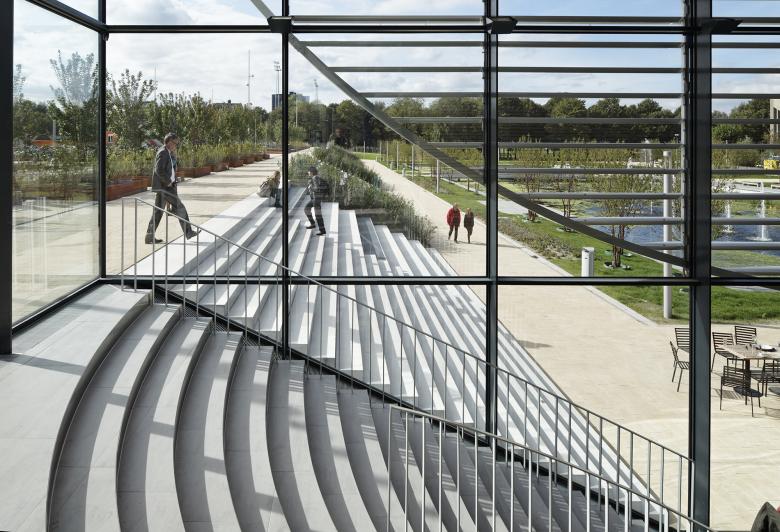
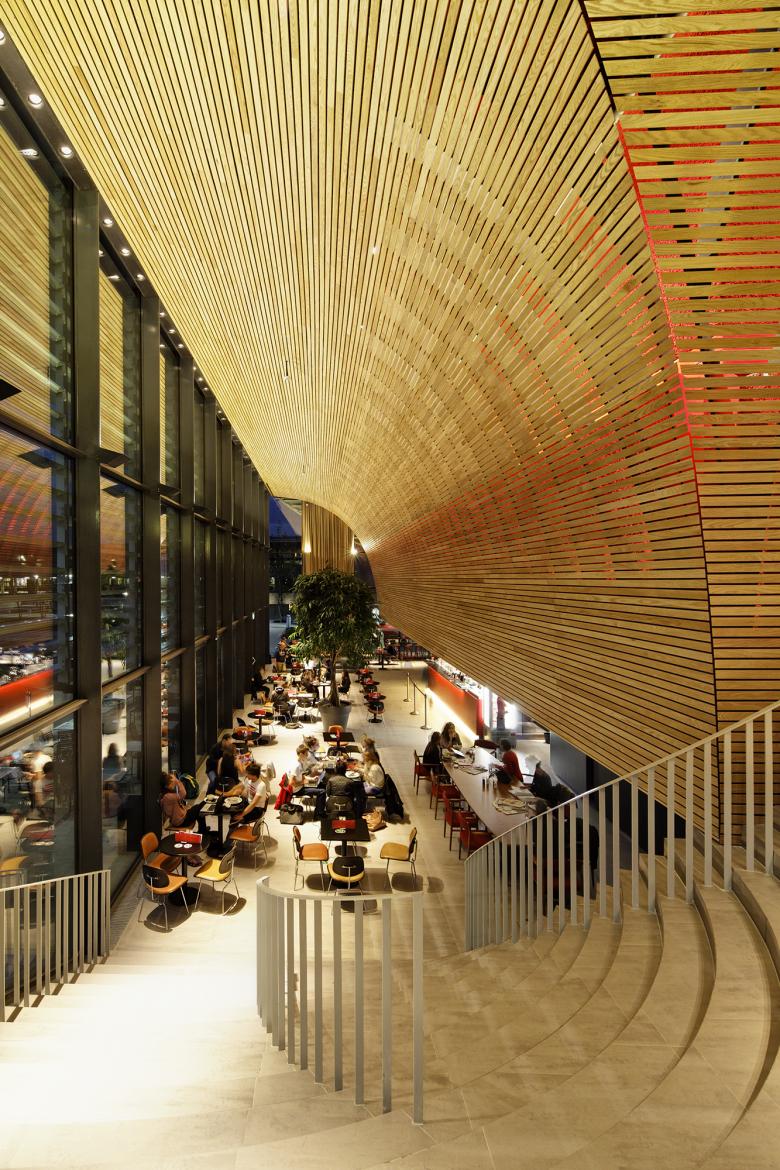
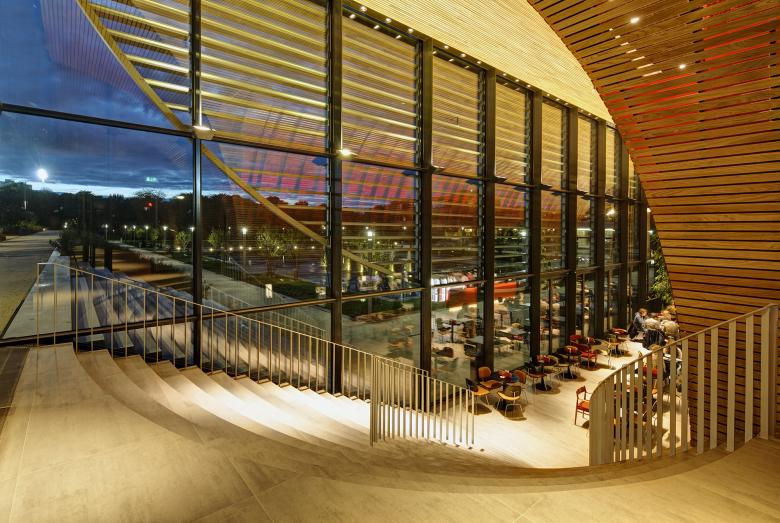
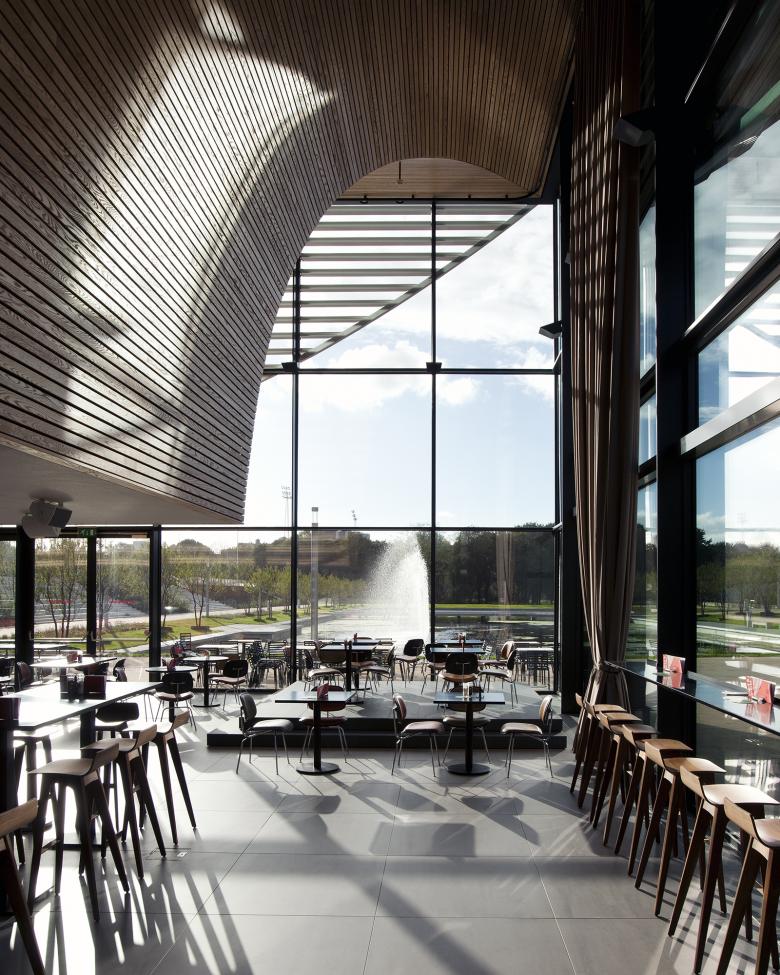
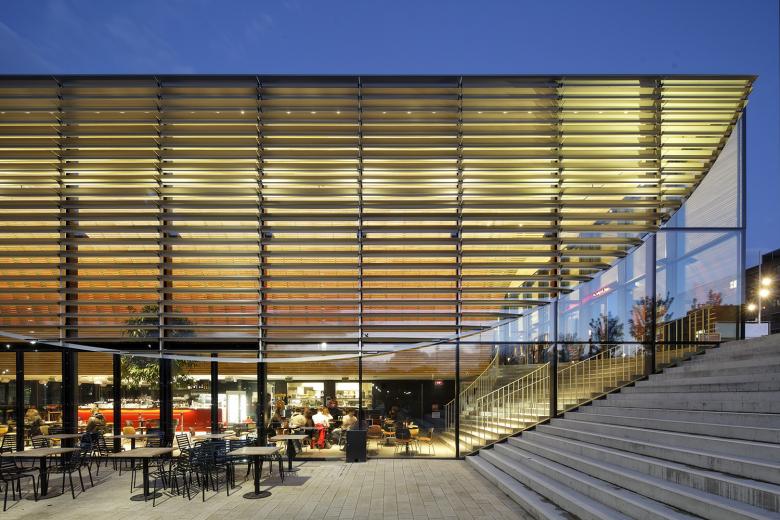
This 'egg in a box' arrangement preserves the transparency of the exterior through its floor-to-ceiling glazing. It allows the pavilion to better connect with its surroundings as well as encourage passersby to flow in from all elevations. To maximise the transparency of the walls, the architect opted for a steel construction with vertical posts of only 20mm and panels 9.5m high. A series of folding doors extends the café onto the terrace overlooking the new lake and fountain in warm weather. As the building is planned over two levels, a grey-tiled curved stair connects the main entrance level to the lower-level café on the ground floor. This stair also links visually to the external stair as part of the landscape redesign.
Intimacy
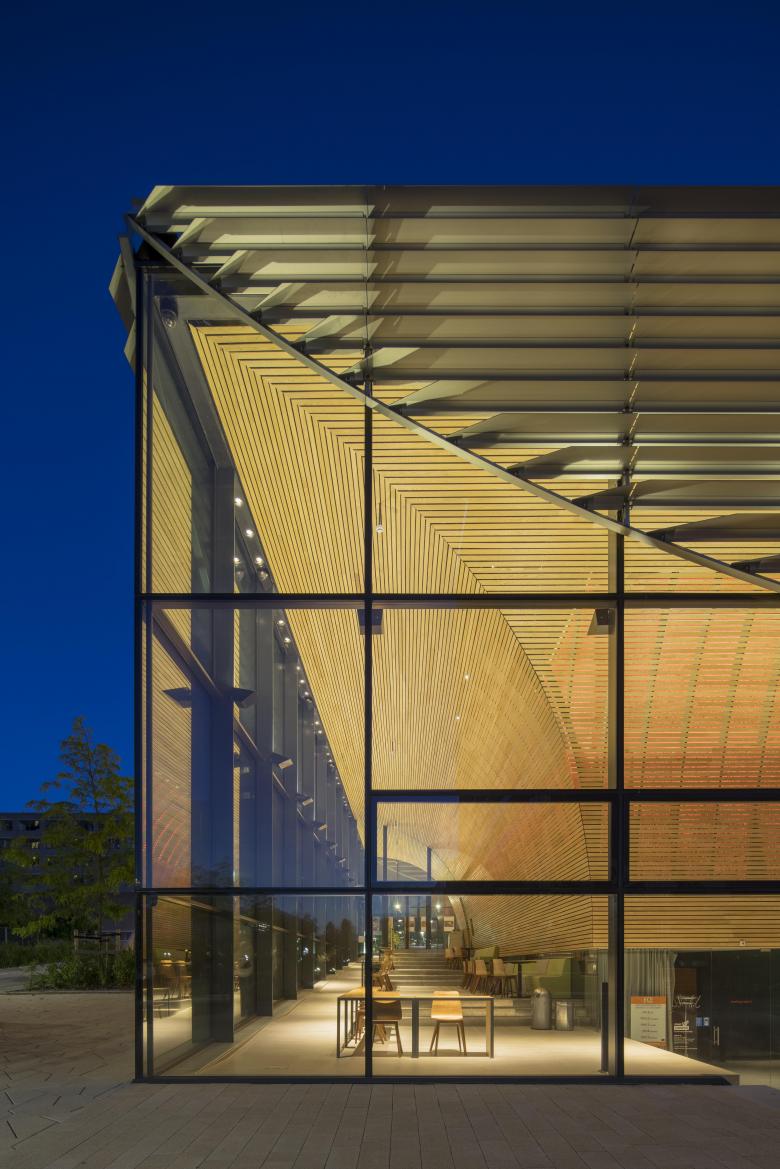
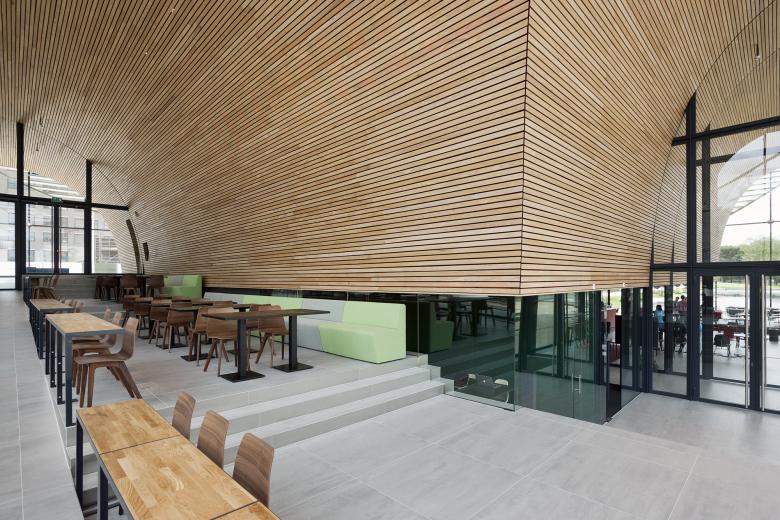
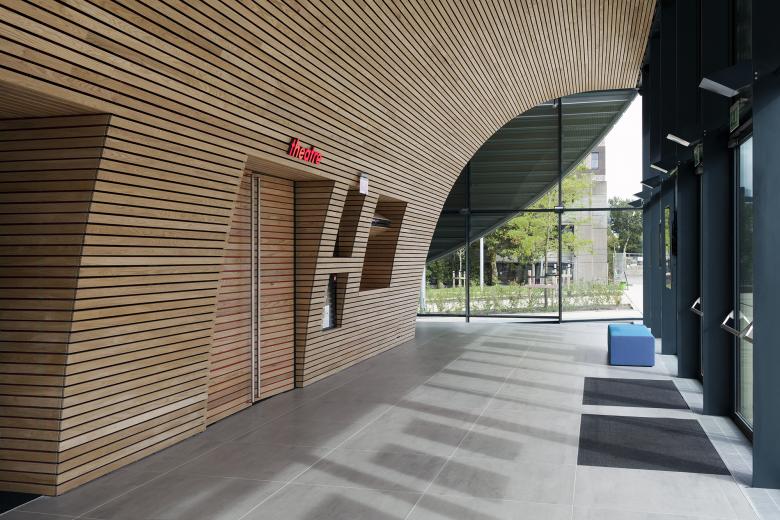
For all the building's openness, however, it was important to create an intimate and inviting environment. As well as the undercroft sections in the Grand Café, the architects added a semi-barrel vaulted suspended ceiling with groin corners around the auditorium. This lath structure – constructed from American red oak– makes an eye-catching feature and softens the materiality of the internal spaces. Furthermore, the red acoustic wall finish behind (a product named ‘Sprayplan’), which glows through the slats at night, provides essential sound absorbing qualities.
Sustainability
The other main objective was sustainability. The design split the building into three climatic zones: the foyer and theatre, study space and café. The foyer and theatre is the only area that is completely mechanically climatised, using the plant located on the ground floor. Meanwhile, the other two areas can be heated in the winter months and cooled in summer through the building's natural ventilation system.
The dynamic facade clearly plays a huge role in this part of the programme. The louvres can be adjusted on hot days to act as a sunscreen and the curved forms that sweep across the four facades are based on the path of the sun to moderate the amount of natural light and heat according to the sun's orientation. This also adds to the sense of intimacy experienced in the building. Depending on the events inside, the lamellae can be opened to bring in light and brightness, and closed by remote control to create intimacy. These louvres are plugged into the building management system (BMS), which intelligently controls the heating, cooling and ventilation. There are windows on the north facade and large hatches in the roof that open automatically for cool air to move freely. For heating, the pavilion has a ground-source heat pump and is connected to the city heating. All of the glazed walls are fitted with triple glazing to further insulate against temperature variations.
In addition to the temperature and ventilation systems, all lighting – even the theatre grid – is LED, resulting in a great reduction in electrical costs. These costs are in part mitigated by the roof, which is fully surfaced with solar panels.


- Anno
- 2013
- Cliente
- Erasmus Universiteit
- Team
- Stefan Prins - Partner in Charge, Nanne de Ru - Project Lead, Sander Apperlo, Anne-Regnhild Larsen, Sybren Woudstra, Søren Harder Nielsen
- Co-Architect
- De Zwarte Hond
- Contractor
- Lokhorst Bouw en Ontwikkeling
- Urban Planner
- Juurlink+Geluk, Sputnik
- Structural Engineer
- Pieters Bouwtechniek
- MEP Consultant
- moBius Consult